Kinley and RAAFT: the business specifiers could finally see
Shortlisted, Construction Marketing Awards 2026, Best Online Platform
Eighteen months ago Kinley was a landscape edging manufacturer, and its website said so. One hero product, AluExcel, and three years without meaningful growth. It could already make far more. The problem was that nobody could see it.
Fabrick rebuilt the brand and the website around the specifier, then kept pace as the business added street furniture, the full furniture range and finally a merger with RAAFT. Three websites in eighteen months, and one product category became five.
The constraint
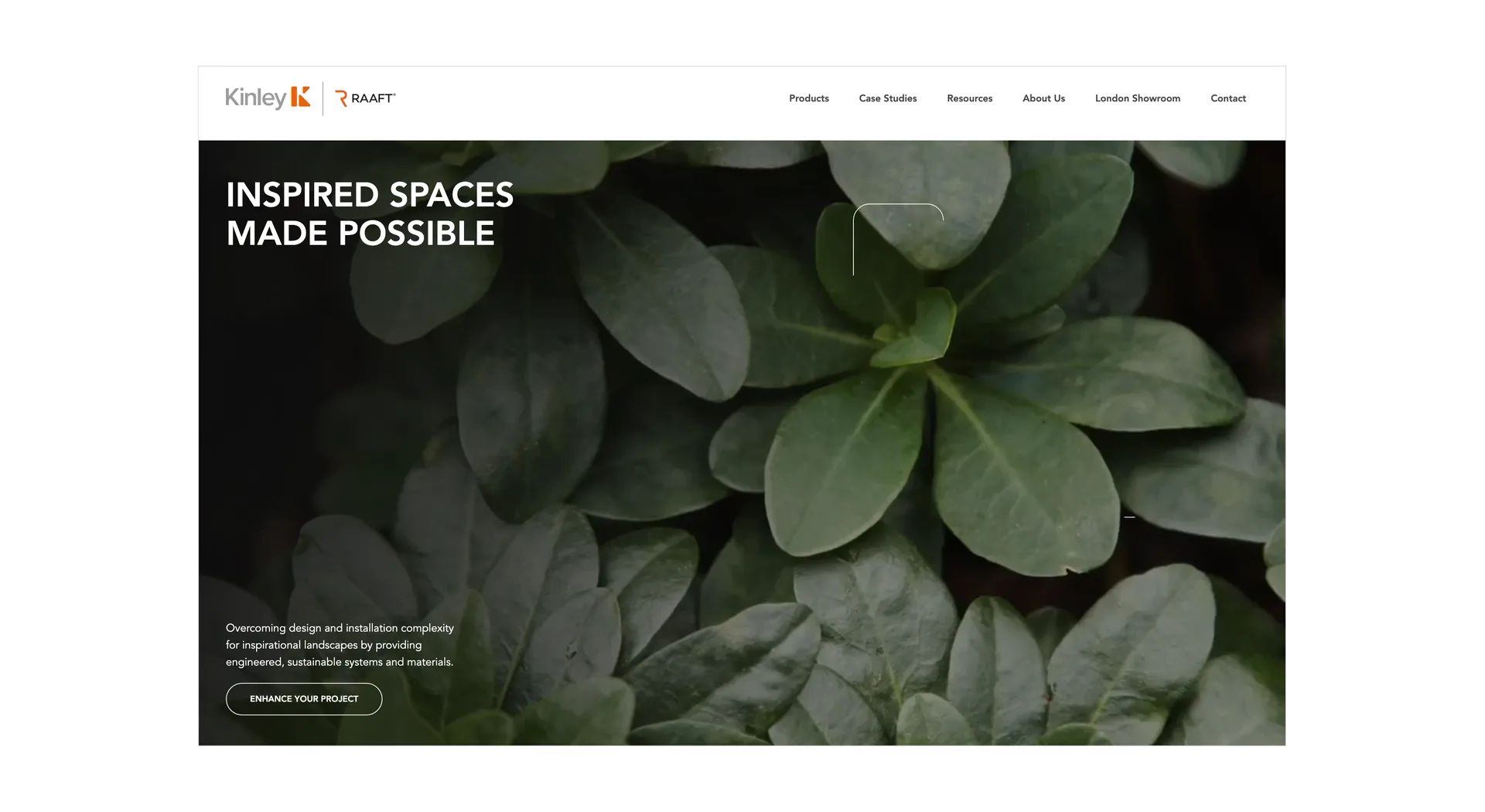
Kinley makes the components of the commercial landscape: the edge, the structure beneath it, the surface, and what stands on it. Almost nobody knew that. The brand said landscape edging, AluExcel was effectively the only product, and the business had not grown meaningfully for three years.
The constraint was not capability or sales coverage. It was legibility. Specifiers could only ask Kinley to quote for what they understood it to make, and a landscape architect arriving at an edging website never reaches the question of what else the company could do.
What we set out to do
Make the whole offer legible, so specifiers could see and specify more than edging. Build a brand and website that grow as the business grows, without a redesign each time. Put the technical answer within reach: details, drawings and downloads, without a phone call. And carry every ranking and every download journey through each change, so growth never restarted from zero.
Kinley wins by being written into the drawing, not by being found in a search for a price. So the primary audience was the specifier: landscape architects, architects, urban designers and masterplanners, who need technical certainty fast and a reason to specify more of the range.
Build one: the site we now show every prospect
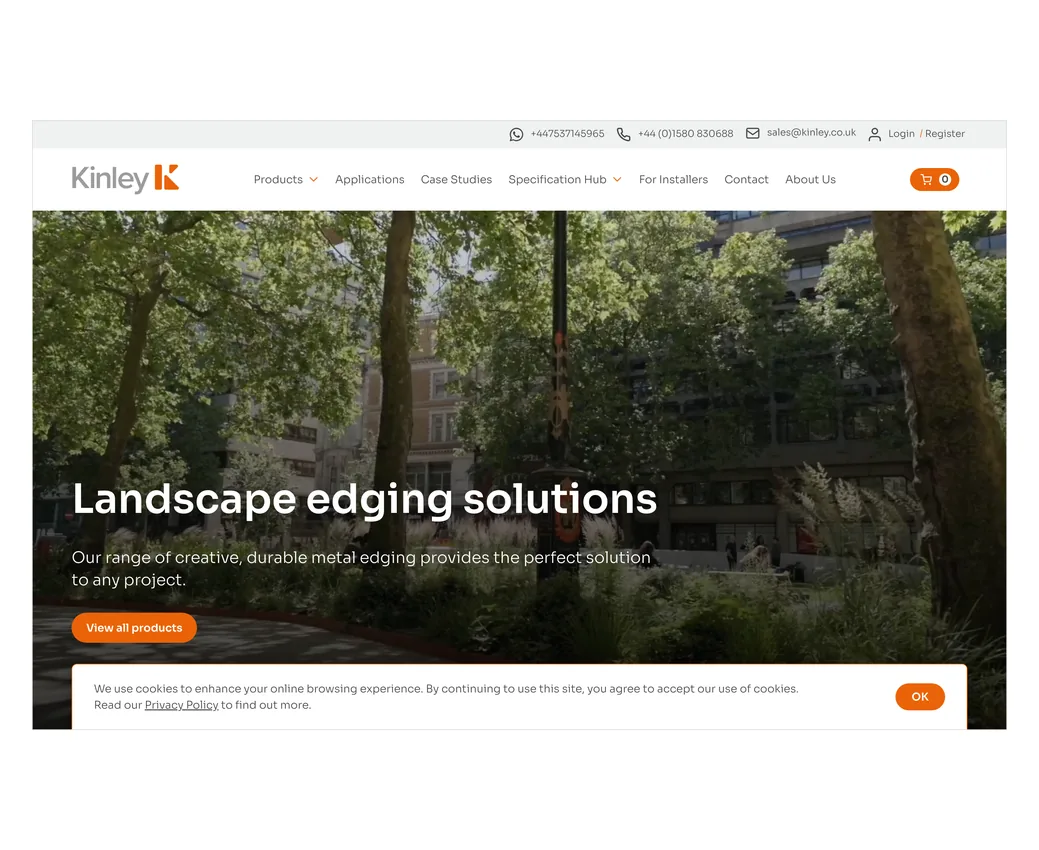
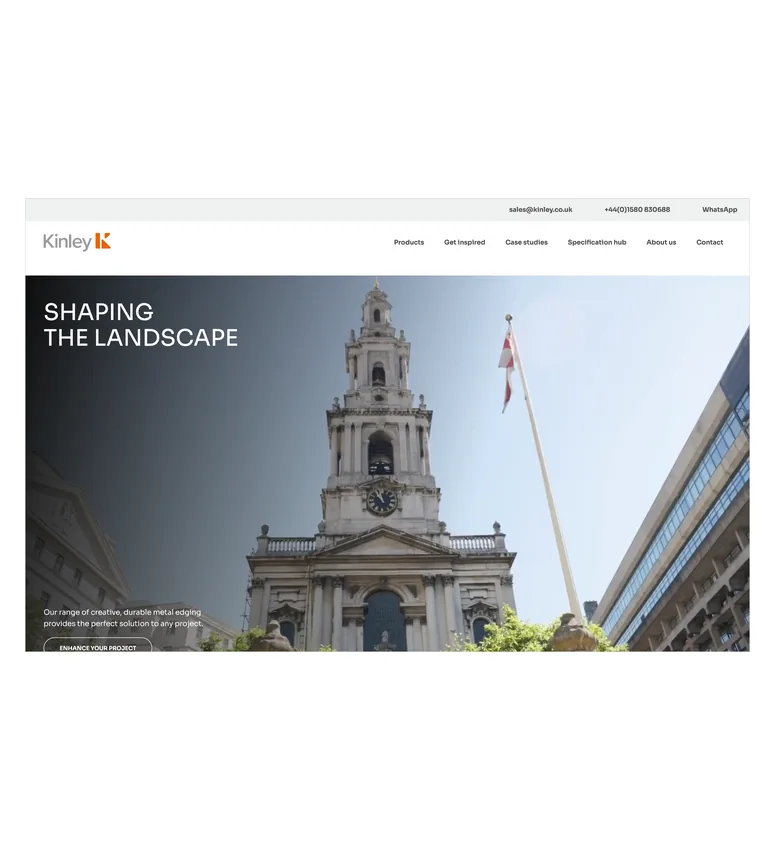
Build one went live in November 2025: a new brand and a new website, both designed and built by Fabrick. The brief was a site that behaved like the products, so the design is minimalist. Generous space, photography of real schemes doing the talking, and subtle animation that rewards scrolling without slowing the page down.
Beautiful, and working. Products lead the navigation, every technical file sits one click from its product, and each download runs through Kinley's own CRM as a named lead with a project attached.
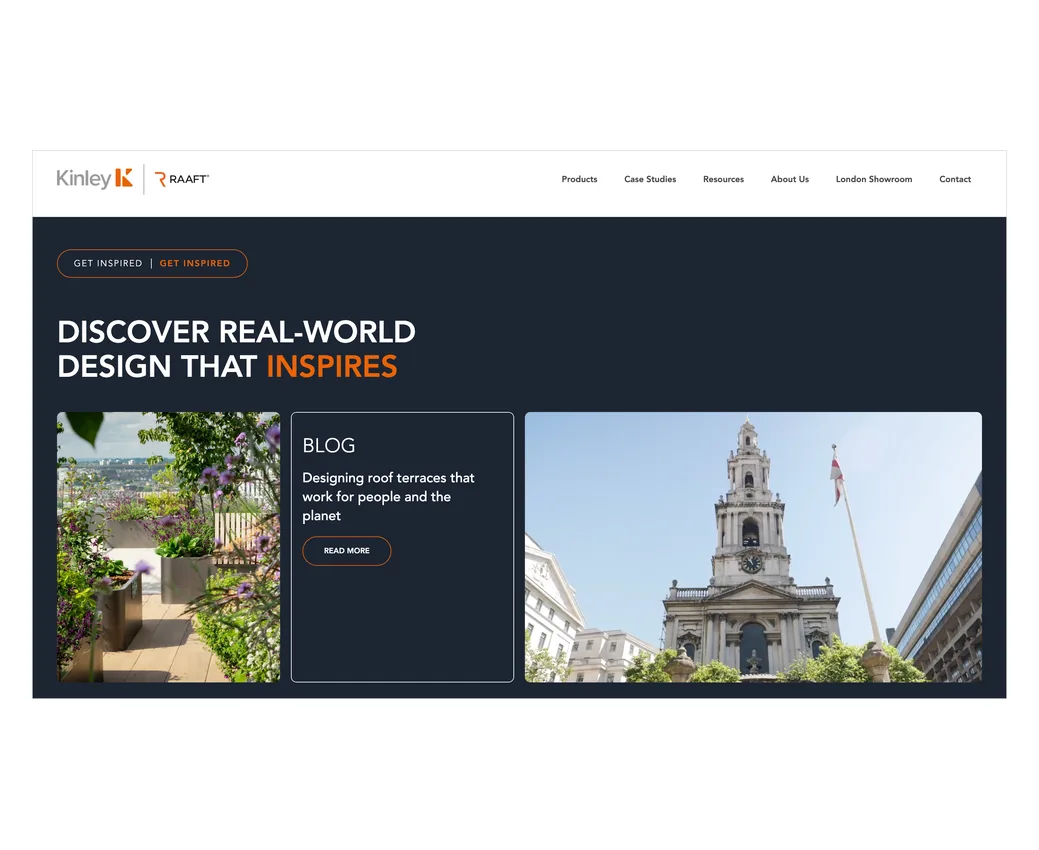
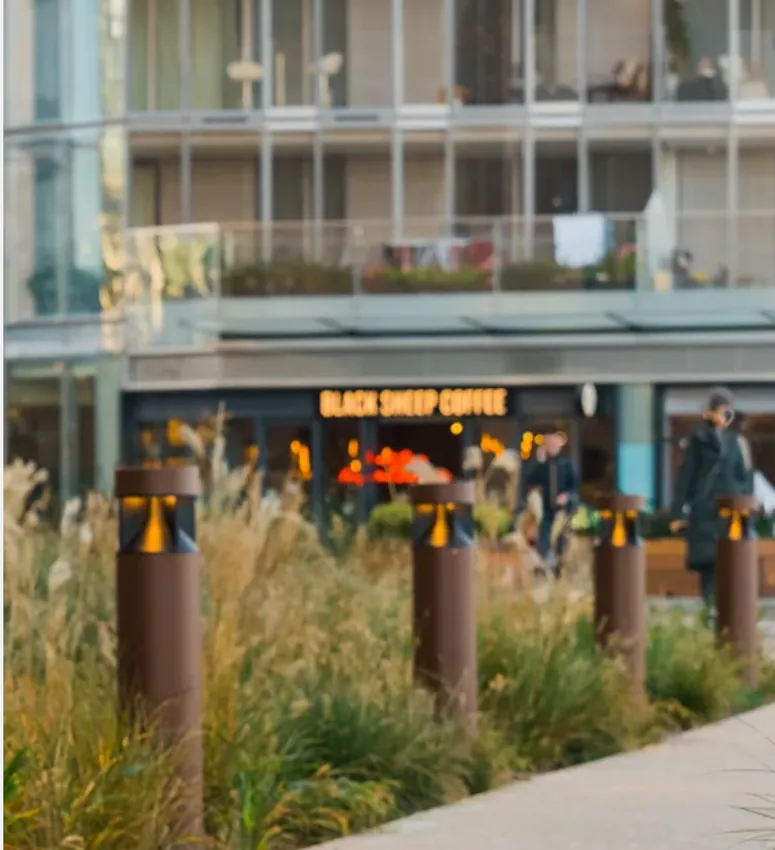
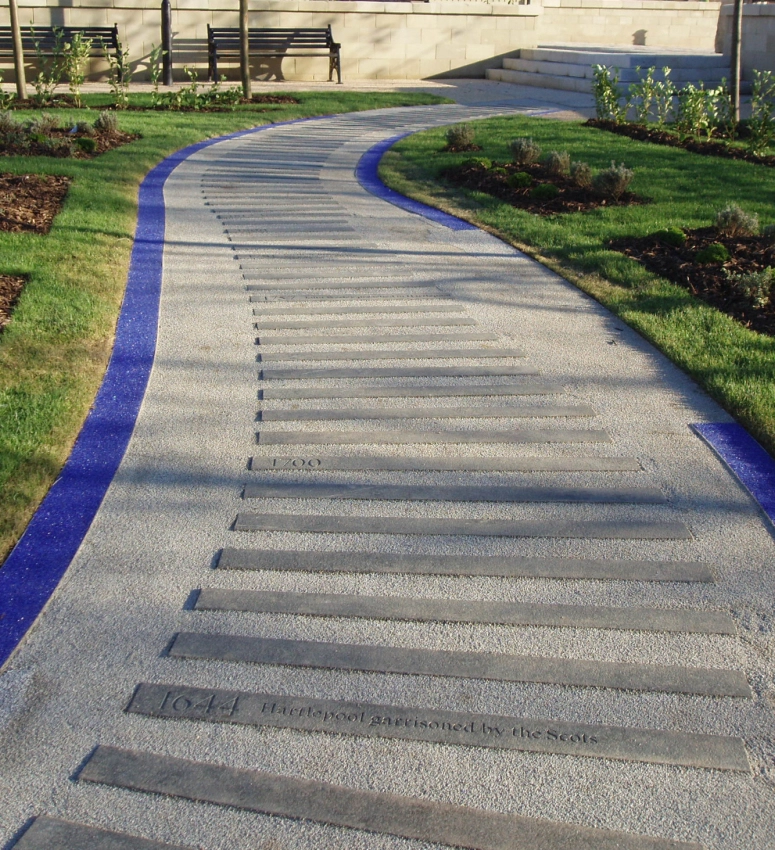
One section was built for a specific reader. A landscape architect who has not yet decided what to specify does not want a datasheet; they want to see what is possible. Get Inspired answers that with real schemes, so a specifier sees Kinley on projects like their own before they pick up the phone. That site is now the case study Fabrick shows prospects when they ask what good looks like.
Keeping pace with the business
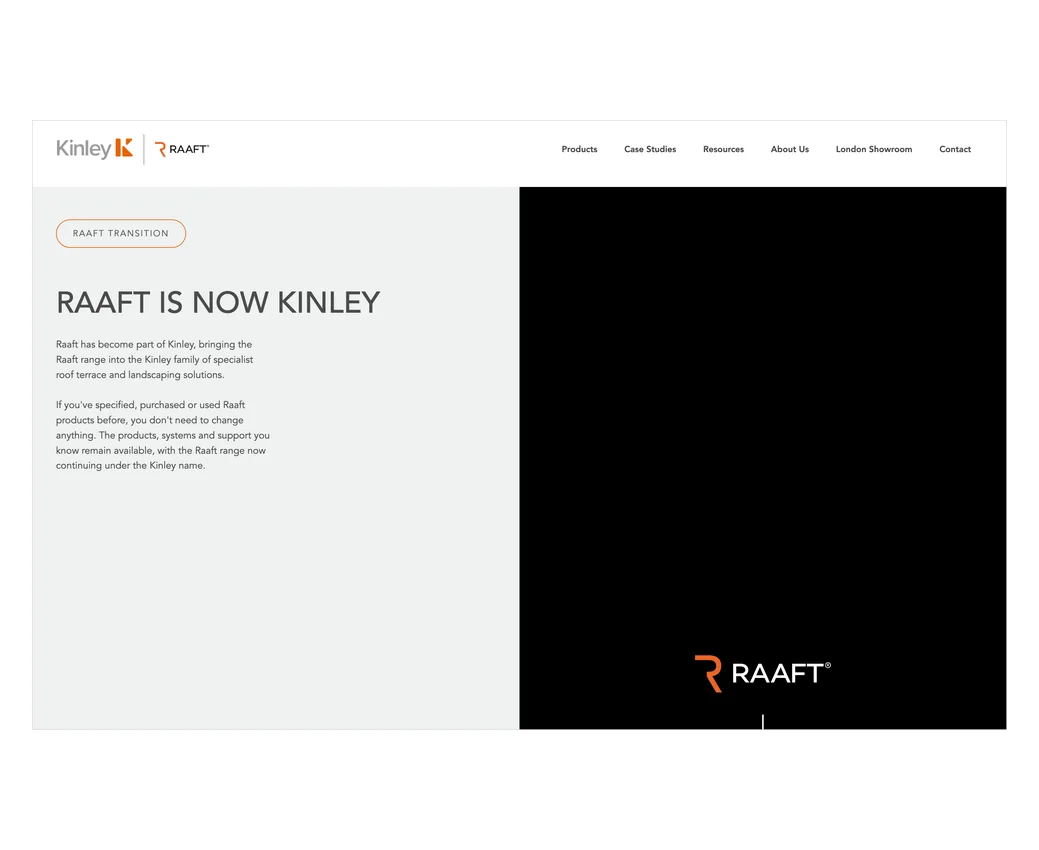
Kinley did not stand still. Street furniture arrived, then the full furniture range, then the merger with RAAFT, whose support systems and surfaces sit beneath the landscapes Kinley edges and furnishes. Each time the business moved, the website moved with it.
Build two, in early 2026, added the furniture range and formalised the brand: how it is shown, how categories are named and coloured. Build three brought the two businesses together on kinleysystems.com, live on 2 September 2026. One product category became five: landscape edging, support systems, surfaces, furniture and planters.
It was a business evolving faster than most, and a team keeping up with it. For the merge we audited both websites, mapped 978 existing pages and wrote 488 redirect rules covering all 29,575 search clicks the two sites earn in a year. Product addresses were kept wherever they already ranked, and the most visited legacy pages were mapped one to one, so no search equity was spent.
An extension of the Kinley team
Fabrick sits in Kinley's weekly design reviews, turns feedback round in days rather than weeks, and builds what the business needs next. By the merger we were working as an extension of the Kinley team: one shared plan, one set of priorities, and decisions made together.
Results
Comparing the nine months after build one went live (November 2025 to July 2026) with the same nine months a year earlier, technical downloads on Kinley almost tripled, from 1,797 to 5,270. Consumer and garden search terms were dropped deliberately, so the site now attracts specifiers rather than gardeners: Google click-through rose from around 2% in 2025 to 5.9% in August 2026. On RAAFT, the average visit grew by a third, from 3 minutes 19 seconds to 4 minutes 24 seconds.
In August 2026, the last full month before the merge, conversions were up 83% year on year on Kinley and 80% on RAAFT, and Kinley's conversions from organic search rose 51% on 31% fewer organic visits. And the merge, which normally costs a site its search traffic for weeks, gained it: in the second week after launch, Google search clicks across the old and new addresses ran 28% above the pre-launch weekly average, with every legacy address resolving.
In the market, specifiers now approach Kinley with larger scopes and a wider product mix. After three flat years, the business grew. It sold because specifiers could finally see it.
0
% rise in technical downloads on Kinley, from 1,797 to 5,270 in nine months
0
% more conversions from organic search in August 2026 than August 2025, on 31% fewer organic visits
0
Website builds in eighteen months, each one reusing the last
0
Product categories specifiers can now see, up from one
0
Legacy pages mapped for the merger of the two websites
0
Redirect rules written, covering all 29,575 search clicks the two sites earn in a year
0
% more Google search clicks in the second week after the merged site went live
0
% more conversions in August 2026 than August 2025 on Kinley, and 80% on RAAFT
We appointed Fabrick 18 months ago; at the point we'd decided Kinley had to become more than an edging manufacturer.
Fabrick came back on the initial enquiry quickly, understood the specification market without needing it explained, and were confident about how they'd carry the brand rather than simply what they'd build. That mattered, because the brief was never a single rebuild. It was to hold a brand together while the business underneath it kept changing shape. Across three builds they've done that: the framework in the first, the formalisation of the identity in the second, and the merged whole-scheme proposition in the third.
The clearest evidence of how well the second was thought through is that its visual system now leads the merged business, a business it wasn't designed for.
Other work
Let’s Talk Ideas
Leave your details below and one of our marketing and PR specialists will contact you to discuss how we can help.